Later – Stephen King
 Later by Stephen King
My rating: 5 of 5 stars
This was excellent. Reminded me of what drew me to Stephen King’s work back when I was a teenager. Jamie Conklin’s narrative sounded like me when I was that age.
Later by Stephen King
My rating: 5 of 5 stars
This was excellent. Reminded me of what drew me to Stephen King’s work back when I was a teenager. Jamie Conklin’s narrative sounded like me when I was that age.

It is funny, I started this post last summer! Summer 2019!! I never got around to finishing it, although summer break is when I usually want to work on my writing. At the very least I spend a lot of time reading. (so far since June, I have only completed 3 books) Now it is Summer 2020, and my thinking on summer is completely different thanks to the coronavirus pandemic.
At least my house still looks exactly the same. Same azalea’s blooming, same state flag flying in the breeze. We love our flag here in Maryland.
Most of the talk between my colleagues and on the news is about the re-opening of schools. When will it happen, should it happen, how will it happen? Lot’s of folks weighing in on the different ideas that are floating around there. The President has made his opinion very clear. The US Department of Education Secretary has made her opinion very clear. The CDC has waffled on the idea, bowing to the opinion of the President. My state has a document, and my district has the beginnings of a plan. But so far, that is all we have. Just ideas.
The Trump Administration has been working on every front to support America’s students during the pandemic. pic.twitter.com/O8aNErlNYz
— The White House (@WhiteHouse) July 7, 2020
The @WhiteHouse Coronavirus Task Force met today to discuss the impact of closed schools on millions of American families & a path forward for reopening America’s schools this fall. For our kids development, our working families, and our economy, we MUST Open Up Schools Again! pic.twitter.com/PAVunK6KX5
— Mike Pence (@Mike_Pence) July 8, 2020
In my head I have been thinking about how things will have to look differently when/if we return to school. All doors propped open? Desks and lab benches wiped between classes? Gloves for students? Masks for everyone. What will labs look like? Can we do labs? What about a student that is only online? Will teachers be asked to do more cleaning? What happens if someone tests positive in the school?
Too much swirling around up there this summer.
This year was my most unusual teacher experience in my 27-year career. Our State Superintendent of Schools announced on March 12th that the next day, a Friday, would be our last in school for 2 weeks due to the COVID-19 outbreak. That 2-week isolation event turned into 10 more weeks with an announcement on April 1st. Remote learning began on April 6th and lasted until the last day of school on June 19th. School events like proms, fundraising, the drama production, concerts, sporting events were all put on hold. One of the worst was the cancellation of graduation with the event moving to a pre-recorded virtual event.
Remote learning was, and is, a challenge. Our district complicated matters by adding an online component that no one had much experience in using, we could not grade assignments – only scoring with feedback, and the entire 3rd and 4th marking periods would be only pass/fail.
Meetings between teachers used a different platform than used with students. Again, not many teachers had experience with that platform. Meetings became more frequent, starting as check-ins, and then more into the business of school. My calendar quickly filled up with content meetings, department meetings, faculty meetings, technology meetings…the list seemed endless. Microsoft Teams, Zoom, and Google Meets became the buzz words of the day.

Our kitchen table quickly transformed into the “home office”. Opening by 7 AM each morning, and sometimes not shutting down for the day until late in the afternoon. I have never been so tired. Sleeping was difficult as my mind raced with thoughts about supporting my teachers and students. I was not the only one. Other teachers in my building reported similar difficulties. Thankfully no one on our faculty was stricken with a case of coronavirus. And just as importantly, not one of my students reported that they had been ill.
Student participation started off fine. Most students were checking in, were doing the tasks that were assigned to them. I think that part of this was the novelty of the situation, some of it was that they were bored with nothing to do. As the spring stretched into the early summer, their participation waned. As the weather turned nicer, and the district shared their grading and reporting policy for the remote learning with students and their families, the students quickly began to withdraw from our online schoolwork. It did not require much for them to achieve a pass for the MP3/4 marking period, and they could opt out of a letter grade for the year if they chose.
AP exams were tough. Reviewing with the students remotely (online) was a challenge. We did our best, but I am not sure that they were as prepared as they would have been if we had been together in the classroom. I usually spend weeks in review, with timed practice tests, and constant review of the free response questions. I think that College Board had the best of intentions when planning the modified exams, but there were many technical difficulties reported and the opportunities for students to violate the rules regarding the integrity of the test were numerous. I had three students that had difficulties with the first round and had to take the makeup test. I later learned that for one student, she continued to have problems with the online format and had to email her responses to College Board. She told me that it was very stressful.
I was able to participate in a couple of online events, that did keep the students attention. One was a Girls in STEM night hosted by one of our clubs. The math department chair had organized some guest speakers, and they shared their experiences with being in a STEM program at college or in industry with about fifty of our students.
Now we are officially on Summer Break. Every teacher I know is anxious about what the new school year will be like. Will it be all online? All in person, like before the pandemic, or some hybrid with some students coming some days, and parts of instruction online? No one has that answer yet. I am usually so excited to see July on the calendar because it means that school is close. My wife says that I actually go into “school-mode” at the end of July as I start planning and thinking about teaching. I am not sure that I have the same excitement this year. More like anxious dread.
Working on a podcast for my school. It is called A Slice of Orange & Black. This has been in my head for about a year. I am using Anchor as the platform for recording. The first few episodes have been easy, and Anchor quickly added my project to 7 podcast platforms! With a little more information, I was able to include Apple podcasts.

Eastern Tech Science National Honor Society contributes to world’s largest periodic table!
2019 is the International Year of the Periodic Table. This year the folks (Michelle DeWitt) at Grand Valley State College are organizing an event to create the world’s largest periodic table. They reached out to groups all across the country to contribute the blocks that represent all 118 elements.

The Eastern Tech Chapter of the Science National Honor Society accepted the challenge, and spent the last few days of school working on our element, Technetium (atomic number 43). What better element to represent Eastern Tech!! We are going with a school color theme of black, orange, and white. They added the Maverick logo in the upper right corner. Technetium is the only known natural element with no known isotopes, and has an atomic mass of 98.
Our element ships out to western Michigan next week to join the 117 others that will be on display in October. The Guinness Book of World Records has been contacted, and we are hopeful that a new world record can be achieved! What a great addition to the history of Eastern Tech as we prepare to celebrate our 50th anniversary! Go Mavericks!!
This is one of the most difficult times for a department chair. There are so many things going on that it is easy to become seriously frustrated. There are times at meetings where you just want to scream, FUCK!! Stop talking to me, I have things to do! (Under Pressure, Queen, 2008)
In the days prior to the return of teachers, the hallways are blessedly quiet. A department chair can walk the halls and accomplish tasks. But after that first day, there is no walking the halls. Every doorway becomes a stop along the way. “Can you help me?“, “I was thinking of of doing something like this…”, “Can you believe what we are being asked to do this year? Why are you chairs not advocating for us?”
Don’t get me wrong, I think I have fantastic teachers in my department, but it is difficult to help them all at the same time. It is like snack time in a kindergarten classroom and everyone wants their chocolate milk at the same time.
The best a chair can do is be prepared. You know what it is going to be like. Have your own shit done so that you can devote most (think all) of your time to your teachers. You know that most of the time will be in required meetings, but have a plan to help teachers in the hours outside of the meetings. And don’t candy-coat your responses. If a teacher is advocating for a 50-foot power cord to stretch across the room creating a safety issue, them tell them what you think. Sometimes they need to hear it out loud before they realize that what you are saying makes sense.
Do not make the rookie mistake of trying to get your department to love you. A chair I know spends over a hundred dollars to buy her teachers gifts to welcome them back to school. Markers, post-it notes, a pencil box. This is not the way to get teachers to follow your plan for the year. Not to mention that it makes other chairs look bad when teachers compare notes at the happy hour that first week.

A strong vision for the year, and leading by example are the best ways to get teachers on board with your plan.


This week began what has become an annual tradition for my AP Chemistry students. Summer Lab! This activity counts as their summer assignment for class. Modeled after the activity that College Board uses to train new AP Chemistry teachers at summer institutes here in Baltimore (thank you Jon Hnatow!) the students do the infamous green crystal lab.
I first ran this activity after attending the APSI at Goucher College in 2011. I had never done the green crystal lab and found it to be a great example of simple lab skills, and a good review of some aspects of chemistry that incoming AP Chemistry students should already have under their belts (stoichiometry, molar dilutions, empirical formulas, formula writing, and redox reactions). This lab experience also checks off several of the old “required” labs that were a part of the AP Chemistry curriculum.


The experience starts before the end of the school year with the Summer Assignments meeting. Students are given the lab handout, a carbon-less copy lab notebook, and the dates for the summer lab. They choose to attend the lab experience or an alternate assignment. Summer lab runs from Monday through Friday, begins around 8:30 AM, and usually ends by 1:15 PM. Students form lab groups (usually pairs) and work together to analyze an iron oxalate compound. The schedule for the week looks like this:
Tuesday afternoon the students also have the opportunity to tie-dye t-shirts. This is a tradition inspired by one of my favorite chemistry professors, who always wore a tie-dyed shirt to class. It makes for a fun team-building activity.
On Wednesday the testing of the crystal really begins. The students determine the percent of water using small samples in crucibles and a drying oven. The nice thing about these crystals is that they change color, from dark emerald green to a light green, when they dry out. Makes it easy to see that the dehydration is working.
Wednesday also increases the skill set with regards to titration. Students titrate a redox reaction between oxalate and permanganate. This one is more challenging than the Tuesday titration for standardizing the NaOH. The redox titration is heated, and acidified. I start the morning, after the first crystals hit the drying oven, with a review of balancing a redox reaction in acid. Then we can connect how water is involved, and how we make this reaction acidic by adding a small amount of 6M sulfuric acid, and 85% phosphoric acid. The students take great care with this titration, as it requires true teamwork to maintain a constant 85-90°C temperature, and hit the color change.
Thursday ratchets up the titration skill. This titration focuses solely on pH and the graph generated by the titration. We use an ion exchange column to substitute H+ ions for the K+ ions in the crystal. Then the students begin a detailed titration using Vernier data acquisition technology, pH probes and LabQuest 2 units. While the ion exchange columns are being re-charged with some 1M HCl, the students gather to learn how to graphically determine the equivalence points on a titration graph with two inflection points. This technique will be used on their own experimentally generated graphs to determine the % potassium and % iron in the crystals. At the end of the day’s work the students are presented with a titration master certificate that they can use in their college portfolios.
Friday is the last day of the summer and the students use their experimental data to determine the empirical formula of the iron oxalate crystal. This part becomes a typical empirical formula problem, where each component is given in percentages, and they calculate the mole ratios for each component. The students turn in their work for each day, showing the calculations for each molarity or percentage that is determined experimentally, and the final empirical formula calculations with a percent yield on the crystal.
A thousand things begin to go through your mind shortly after July 4th when you are a high school department chair. Schedules, class sizes, materials, textbooks, new teachers, retiring teachers, new administrators, new duties, projectors, printers, computers, enough desks and chairs for each room! Where does the “to do list” end?
As most teachers “roll over, and go back to sleep” in the early to mid-July time frame, department chairs are often in the beginning stages of “school mode”. That is a phrase my wife uses when I begin to drift off into a fugue state where my mind is racing with things that I need to work on when I return to school before my teachers do. I believe that “school mode” gets triggered with the first of the school supplies that hit the store shelves in early July. I usually start with buying a new planner for the school year. (although this is quickly being replaced by an online tool)
My first days back in school usually happen in early August, so that I have time to check on things.

I begin to make lists like crazy. I have about 15 people in my department that teach a total of 20 courses. I start my summer with a quick inventory of what we have on hand. I try to ask each teacher to anticipate needs for the coming school year.
Each teacher has needs, each teacher’s classroom has needs, each course has needs. I start with how many sections of each course are running and think about books, projectors, document cameras. Those are the items that I need to make sure are in-house and ready when school starts. These are the big money item and can take the longest to reach the building (like furniture).
I usually bring my tool kit to school in those early days of August. Sometimes I can fix a wobbly leg, or loose desk top with a little glue, and a screwdriver. We have some heavy resin-topped lab tables that seem to take a beating when the custodial crew gets through with the summer cleaning. I have fixed quite a few broken table legs.
If the schedule is done, I start looking at class numbers, and the schedule of the department members. I look for class sizes, common planning time, and start to think about the observation calendar. I would like to think that I can contribute to some small changes but this usually depends on when the schedule is ready and if the scheduling AP is open to a few small tweaks.
Once school starts for teachers my life is a whirlwind of activity. There is little time for repairs, inventory, and analyzing the schedule.
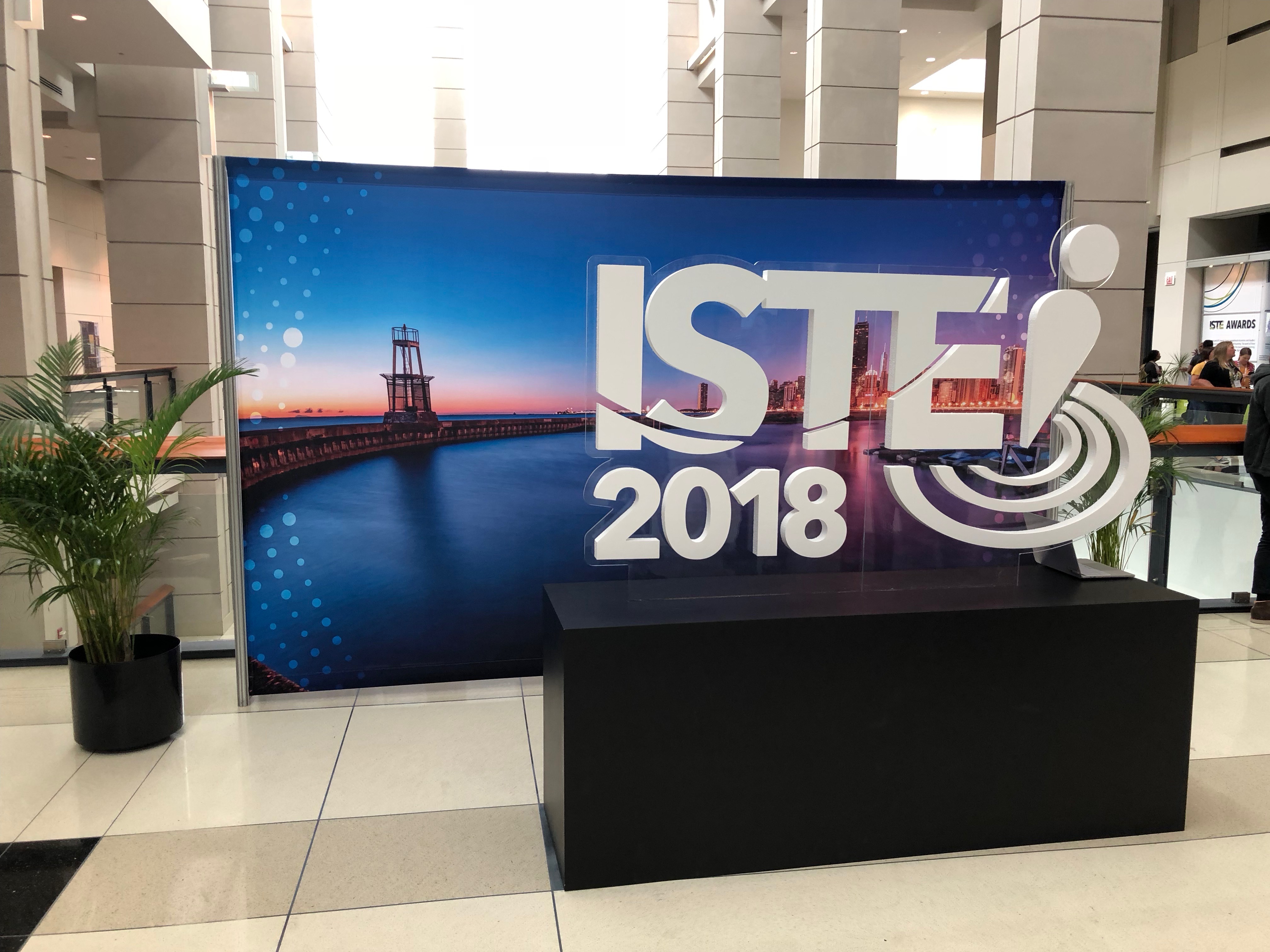
Just returned from my one and only conference of the summer. ISTE 2018 was in Chicago this year and did not disappoint. The town is amazing, beautiful, and friendly. My hotel was a couple of miles from the conference center, but I didn’t mind the walk. I got to see Millenium Park every day.
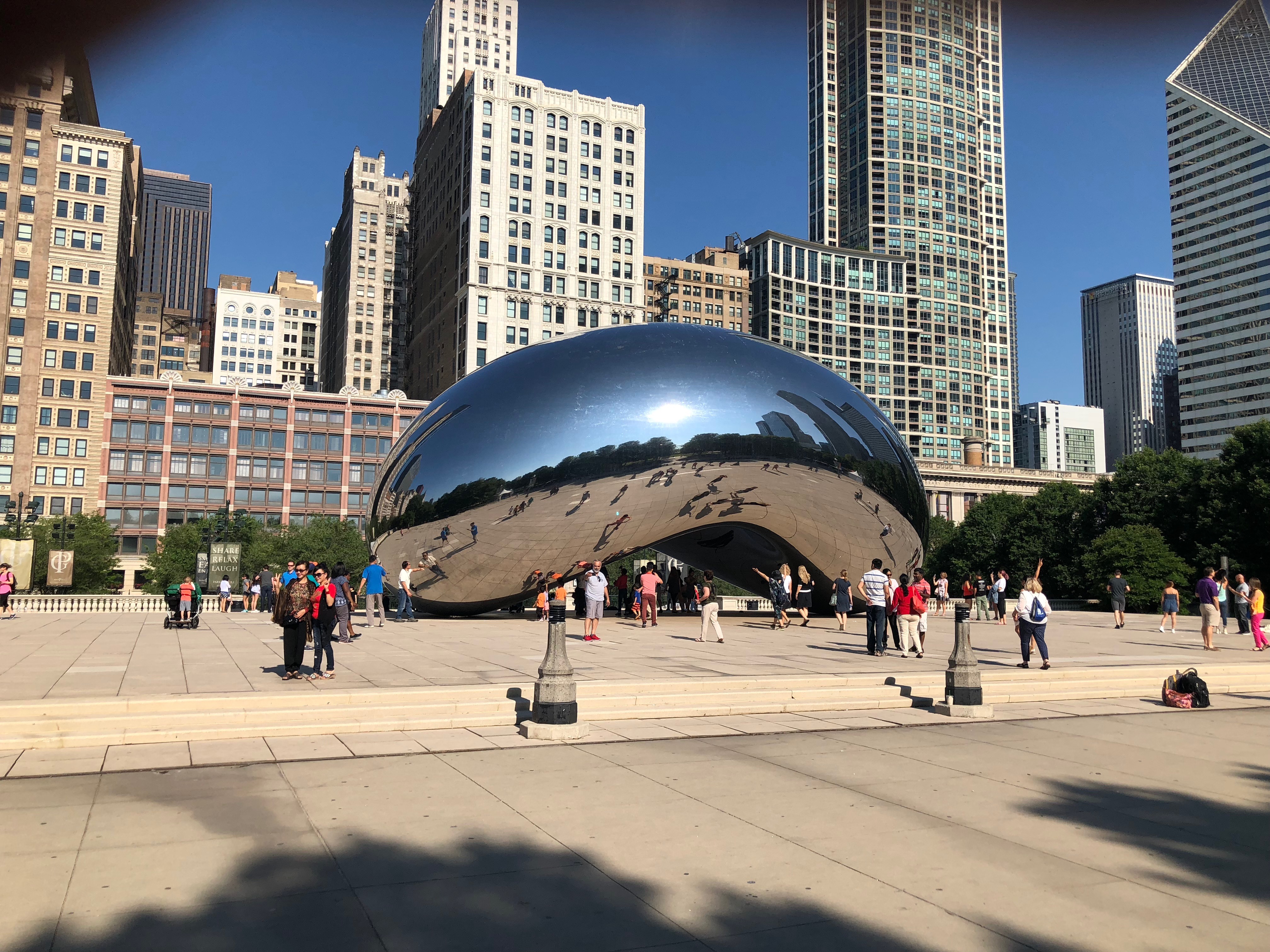
ISTE is an educational technology conference. There are sessions about integrating technology into your classrooms, about new instructional tech that is coming onto the scene, and about improving your teaching practice. Microsoft, Apple, Google have a giant presence at this conference. Many, many sessions just from these three technology giants.
There were three keynote addresses, but I only attended one. It started with a mini-concert from the group, Musicality. They are a high school group that once appeared on America’s Got Talent. Fantastic way to start the show!
Easily the best highlight of the conference! #ISTE2018https://t.co/X4CGqB35XG
— TMichocki (@TMichocki) June 28, 2018
Author Andy Weir (@AndyWeirAuthor) did not disappoint. His session about how he started as an author was fantastic. His message was about problem-solving, never giving up, keep moving forward.

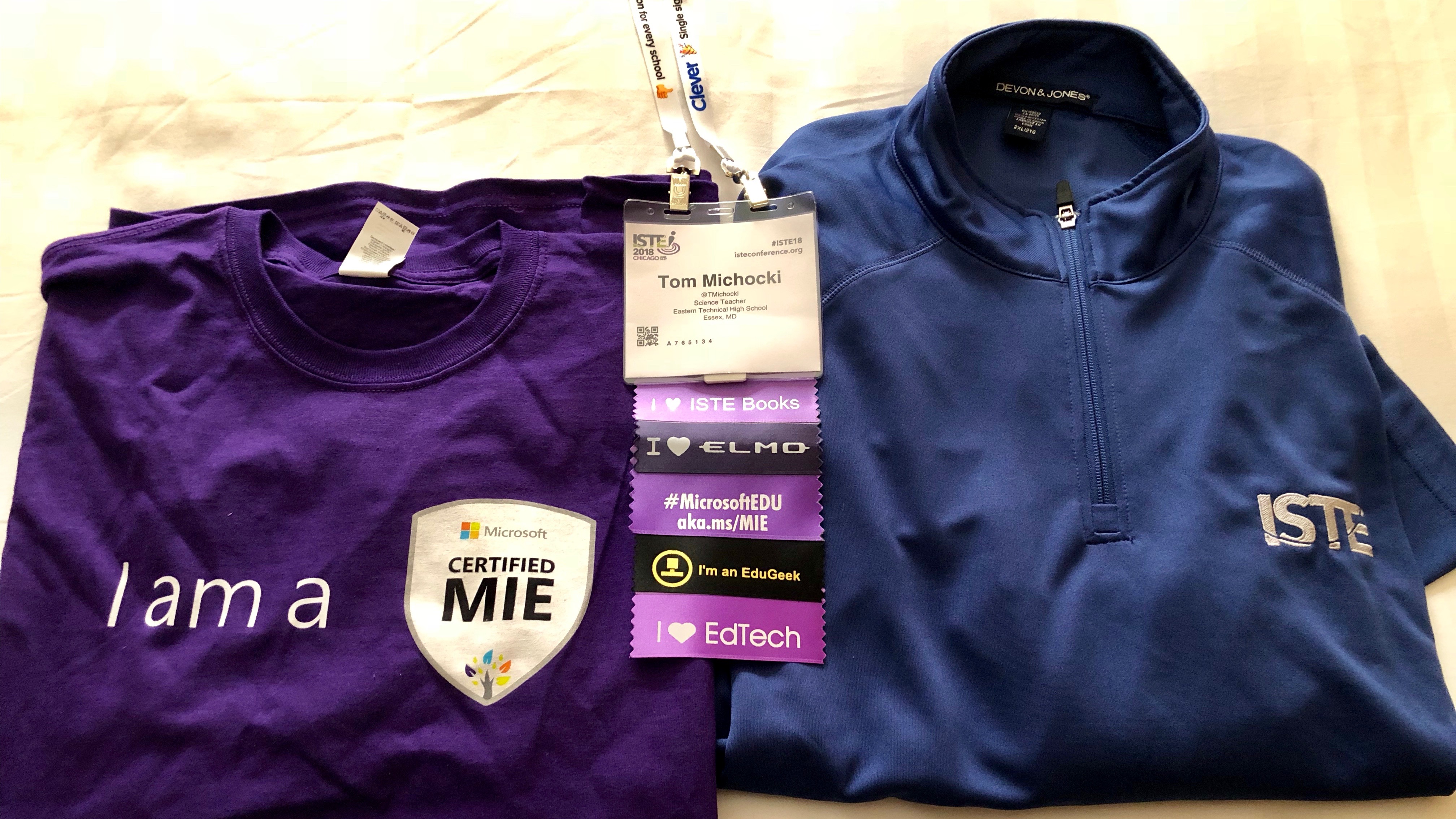
I scored a free Microsoft Innovative Educator T-shirt from the Microsoft booth, and bought a shirt from the ISTE sales booth.
I have to say that the size of this conference can be overwhelming. It took me several hours to make my way through the Expo floor where the vendors are showcasing their products. The program of sessions is extensive and it really becomes a matter of priority when deciding where to go next.
I did get to meet one of the big-cheeses from FlipGrid. Joey Taralson is really down to earth, and easy to talk to. His company was just purchased by Microsoft, but he is still the same person that I met last year.
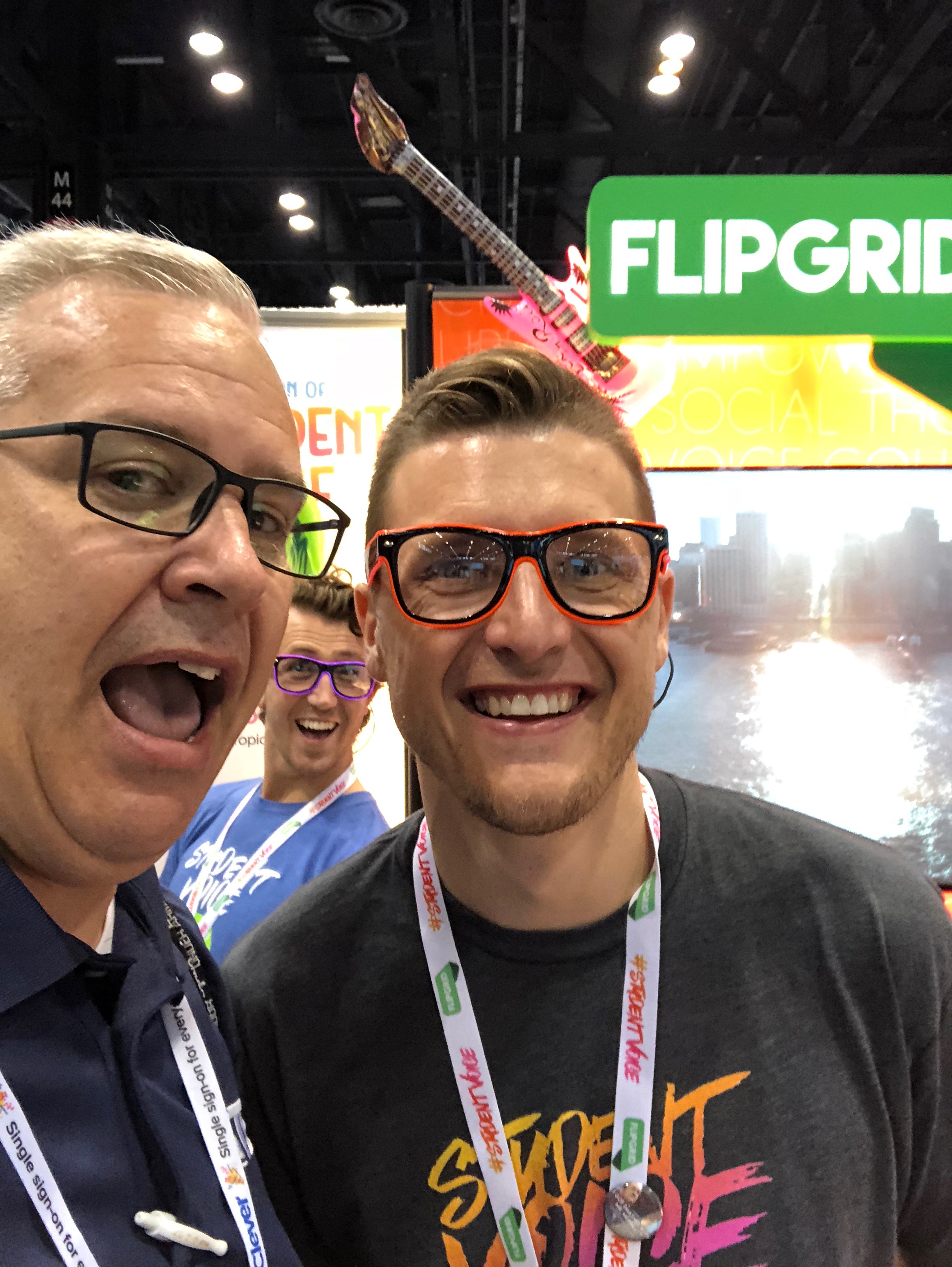
FlipGrid is all about student voice, and I have used it in both of my AP classes. The students really like it, and I get to hear what is uppermost on their minds in response to a simple prompt.
While at the conference I finished by 2018-2019 Microsoft Innovative Education Expert application. Most of this time was spent on the 2-minute Sway. I was an MIEE last year, and it gives some credibility when presenting a new Microsoft tool to a group of teachers. I find out on August 23rd if I made the list again for this year. Fingers crossed.
One of my regrets from the conference was BCPS leadership. I saw directors and office-heads from my district, a couple that I know personally. In every case, they turned their back as soon as they saw me or ignored me completely. There were a handful of teachers from our district at the conference, and I cannot say that they all had the same reaction, but this was my experience. It just further divides the elitism that seems to exist between the district administration and the classroom teacher.

This was definitely one of the most challenging weeks of the year so far. Early in the week, there was a photograph posted online that depicted one of our students with a racial slur. This image quickly went viral with nearly every student in the school involved. http://baltimore.cbslocal.com/2017/03/02/protest-at-eastern-technical-hs-after-racist-picture-appears-on-social-media/
Word quickly spread amongst the students that they would protest the image, and what appeared to be a lack of consequence from the school administration. There had been a consequence, which was in accordance with the student behavior handbook, but the students did not believe that it was equal in severity to the incident. http://foxbaltimore.com/news/local/the-real-eastern-tech-rallies-against-racist-snapchat-photo
Beginning early before MOD 1, a group of students sat on the lobby floor. They texted, Snapped, Instagrammed, and Tweeted their location to most of the student body, and the local news. Soon, dozens of students joined them. When asked to return to class, they refused. For safety, they did agree to re-locate to the school cafeteria. They continued their peaceful protest for the remainder of the first period. The size of the crowd grew with the first change of classes. There were now over 100 students involved, with more arriving during the second period.

The sit-in protest turned into a platform for expression of thoughts, feelings, and experiences. The student crowd was joined by a few teachers. They read aloud from letters and poems that captured the feelings of others when faced with such open racism. The news reporters were not allowed inside but remained in contact with our students through social media. http://www.wbaltv.com/article/eastern-tech-students-protest-racial-slur-on-baseball-field/9084532
The group was allowed to protest after lunch in the main gym. Now, 100’s of students were on site. The testimonials continued throughout the remainder of the day. Most of my students came to ask me if they could attend before doing so. A few chose to remain with me. I told them that they should “do what they need to do“.
In all my years of teaching, I have never been a part of such an event. I do not believe that this peaceful assembly could have happened at most other schools. There were no fights, no violence of any sort. The only members of the community that were angry were some of our parents. They were furious that this type of protest was allowed to happen. They wanted their children back in class. I would have to disagree. Our students needed the opportunity to voice their feelings. They did so in a way that should be an example to others.
Proud of them. Proud of our school.
 The Frustrated Chair